How to Start Freelancing Without Experience: The Ultimate Beginner's Guide
Becoming a freelancer is one of the most exciting choices you can make for your career. It opens the door to total flexibility, location independence, and complete control over how much money you earn. You no longer have to commute to a 9-to-5 job, answer to a difficult boss, or wait a whole year just to ask for a small pay raise.
However, almost every beginner runs into the exact same giant obstacle in their head: “How in the world can I start freelancing if I have zero experience?”
If you are asking yourself this question, you are not alone. It is the single most common fear that stops talented people from ever getting started. Most aspiring freelancers assume that clients only hire experts who have corporate degrees, ten years of agency work, or a massive portfolio of past clients.
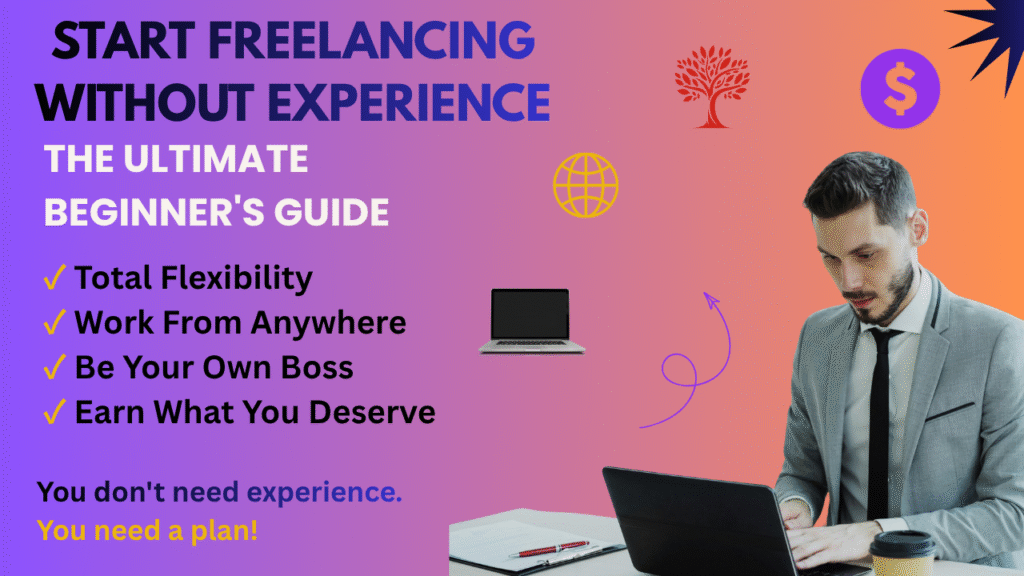
Here is the plain, simple truth: Clients on the internet do not care about your past titles or your degrees. They only care about whether you can solve their immediate problem right now.
If you can write a clear email, design a clean image on Canva, organize a messy spreadsheet, or build a simple website, you already have a skill that businesses are actively paying for every single day. You do not need a fancy background to start working online—you just need a clear plan, a bit of practice, and the right strategy to show people what you can do.
In this detailed step-by-step guide, we will break down the exact path to building a successful freelance business from total scratch, even if you are starting from complete square one today.
1. The Big Mindset Shift: Moving from Employee to Business Owner
Before you open a single account on any job board or write a single word of your profile, you need to fix your mindset. Switching from working for a company to freelancing requires you to completely change how you think about work.
When you work a normal job, you are an employee. Your manager tells you what to do every morning, gives you a list of tasks, and at the end of the month, you get a fixed paycheck regardless of how much revenue the company brought in.
When you become a freelancer, you are no longer just an employee. You are a business owner.
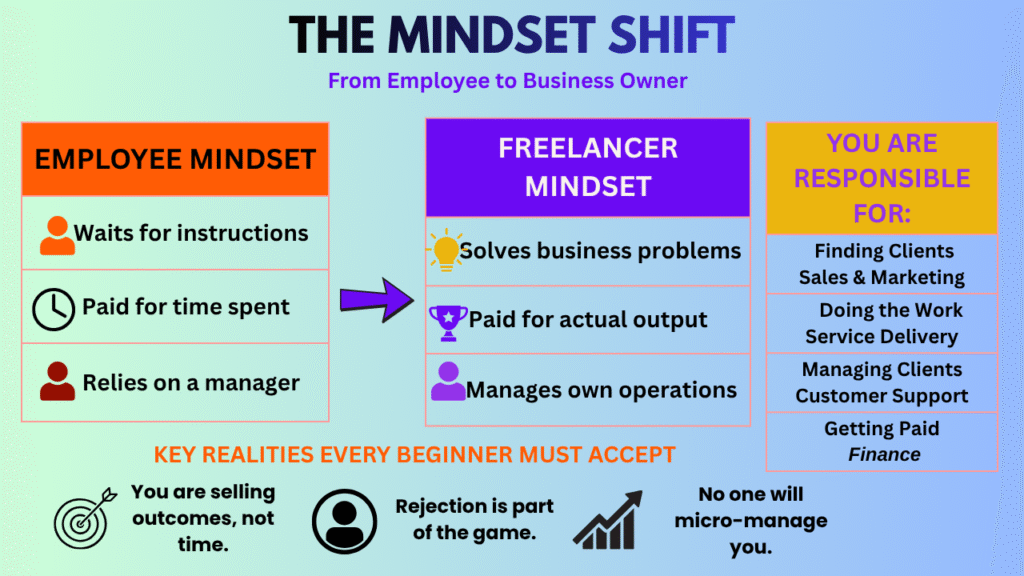
Even if you are a solo freelancer working from your laptop in your bedroom, you are running a micro-business. This means you are responsible for everything:
- Finding your own clients (Sales & Marketing)
- Doing the actual work (Service Delivery)
- Sending invoices and collecting payments (Finance)
- Managing deadlines and client emails (Customer Support)
Key Realities Every Beginner Must Accept
- You are selling outcomes, not time: Clients do not want to buy eight hours of your day. They want to buy a finished blog post, a fixed website, or an organized calendar that saves them stress.
- Rejection is part of the game: In the beginning, you will send ten proposals and might only hear back from one person. That is completely normal. Freelancing is a game of daily consistency.
- No one is going to micro-manage you: Freedom is amazing, but it can also be dangerous if you lack self-discipline. If you do not sit down and pitch clients today, you will not get paid next month.
2. Uncovering Your Hidden Skills (Auditing What You Already Know)
The biggest myth in the online world is that you must spend six months taking expensive courses before you can offer a service. The reality is that you likely already possess several everyday skills that businesses desperately need help with.
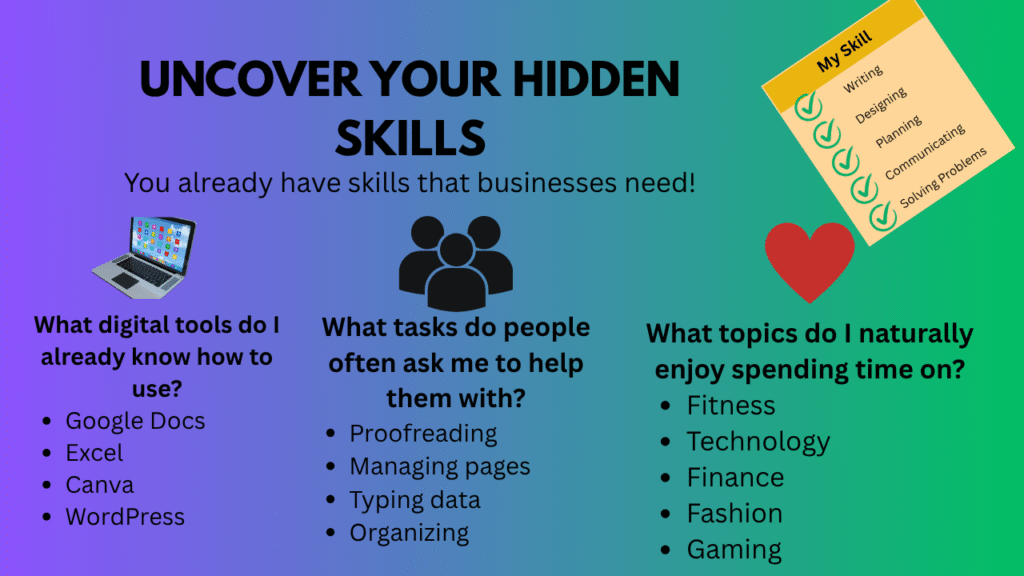
Think about your daily life, your hobbies, or past casual activities. Have you ever written essays for school? Have you created posts or reels for your personal social media? Have you helped a friend organize a event schedule? All of these contain the seeds of real freelance services.
To figure out what service you should offer, grab a notebook and answer these three core questions:
- What digital tools do I already know how to use? (e.g., Google Docs, Excel, Canva, Zoom, CapCut, WordPress)
- What tasks do people often ask me to help them with? (e.g., proofreading documents, setting up social media pages, typing data)
- What topics do I naturally enjoy spending time on? (e.g., fitness, technology, fashion, finance, gaming)
High-Demand Entry-Level Freelance Niches
To give you a clear idea, here is a detailed breakdown of beginner-friendly services that require zero corporate background to learn and launch:
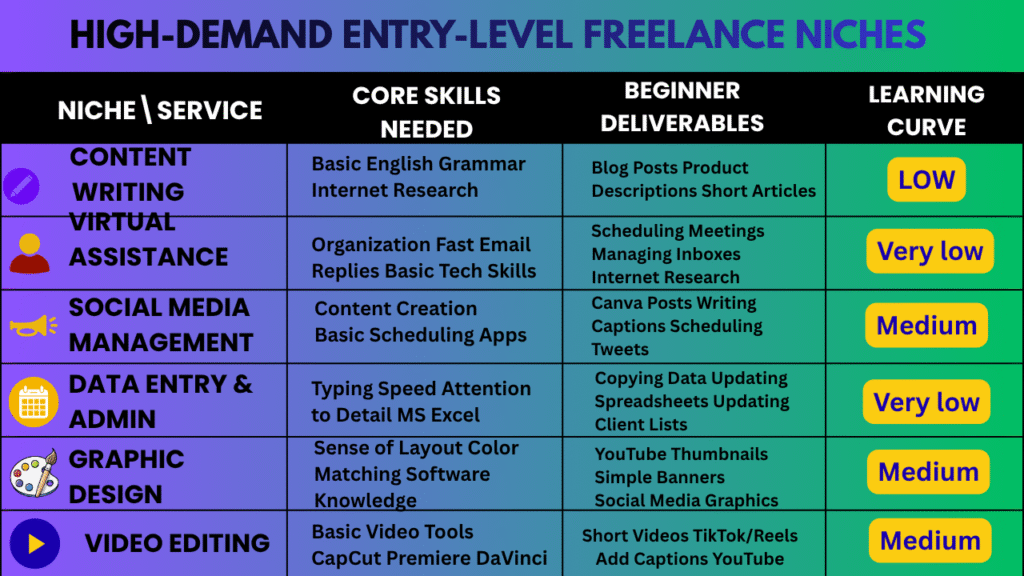
The best place to start as a beginner is right at the intersection of what you are decent at and what small business owners hate doing themselves. Business owners are busy. They would gladly pay you $15 to $20 an hour just to take tedious, time-consuming tasks off their plate.
3. Setting Up Clear, Realistic Freelancing Goals
Starting without a clear destination is why so many beginners get overwhelmed and quit after two weeks. Before you create any online accounts, sit down and set realistic, concrete targets for yourself.
Ask yourself why you are doing this:
- Are you looking for a side hustle to earn an extra 200–500 a month to pay off bills?
- Or are you trying to build a full-time career to replace your main income over the next six to twelve months?
Your strategy will change depending on your answer. If you need quick extra cash, you should focus on simple, high-volume tasks like data entry, basic writing, or simple Canva graphics. If you are building a full-time career, you need to pick a specialized skill (like SEO writing, video editing, or web development) and commit to mastering it over time.
Setting SMART Freelance Goals
Instead of saying: “I want to make money online,” frame your targets using the SMART framework (Specific, Measurable, Achievable, Relevant, Time-bound).
- Bad Goal: “I will try to get some clients on Upwork soon.”
- Good Goal: “I will send 3 personalized proposals every day, 5 days a week, until I land my first paid client within 30 days.”
Having a clear daily input target (like 3 proposals a day) gives you total control over your actions. You cannot force a client to hire you, but you can 100% control how many proposals you send out every morning.
4. How to Build Proof of Work When You Have Zero Past Clients
This is the famous dilemma every beginner hits: “How can I get hired without a portfolio, but how can I build a portfolio without getting hired?”
The good news is that you do not need real, paid clients to create a powerful portfolio. Clients do not care who you made the work for—they just want to see what your work looks like. You can easily build a impressive portfolio from absolute scratch by creating speculative work .
3 Ways to Create Sample Work Today
Method 1: The Fictional Brand Project
Invent a fake company in your head or use an AI tool to generate a prompt.
- Example for Writers: Imagine a fake local coffee shop called “Green Leaf Cafe.” Write a 1,000-word blog post titled “5 Reasons Organic Coffee is Better for Your Health.”
- Example for Designers: Create 3 different Instagram graphics and a banner for a fake gym or fitness brand.
- Example for Virtual Assistants: Create a clean, organized sample Excel sheet tracking sales data or build an organized weekly schedule template.
Method 2: The Free Redesign / Rewrite
Find a real small business in your town or on the web that has a poorly formatted website, weak social media graphics, or bad text.
- Rewrite their homepage copy or redesign two of their bad social media posts.
- Include both the “Before” and your new “After” version in your portfolio. This visually proves to clients that you know how to upgrade their quality immediately.
Method 3: Volunteer Work
Offer your service for free to a local non-profit, a local charity, a school club, or a friend who owns a tiny business. Do one or two quick projects in exchange for a written review and permission to showcase the work.
Choosing Where to Host Your Portfolio
You do not need to spend money building a complex, expensive website when you are starting out. Keep it super simple:
| Platform Type | Best For | Ease of Setup | Cost |
|---|---|---|---|
| Google Drive Folders | Documents, Spreadsheets, PDF samples | Super Easy | 100% Free |
| Notion Page | Clean, modern visual organization | Easy | 100% Free |
| Behance / Dribbble | Graphic designers, visual artists | Easy | 100% Free |
| Canva Website | Simple 1-page visual portfolios | Easy | 100% Free |
| WordPress / Webflow | Advanced custom branding | Hard | Paid Host Needed |
Pro-Tip: Organise your Google Drive or Notion page cleanly. Create folders labeled by topic (e.g., “Health Samples”, “Tech Samples”) so a client can easily click and view your best work in seconds.
My Experience Starting Freelancing Without Experience
When I first started learning about freelancing, I had the same problem that many beginners have: I knew I wanted to work online, but I didn’t have any client reviews or a proper portfolio.
At first, I thought I needed to become an expert before sending my first proposal. I spent a lot of time learning and preparing, but I wasn’t actually reaching out to clients.
Things started to change when I began creating sample projects and treating them like real client work. I also started sending more personalized proposals instead of using the same message for everyone.
I didn’t get results immediately, and some proposals were ignored. But each response helped me understand what clients were looking for and how I could improve my approach.
That experience taught me one important lesson: you don’t need to wait until you feel completely ready. Start with what you know, create proof of your skills, and improve as you go.
5. Setting Up Your Workspace and Daily Work System
When you work from home, it is incredibly easy to lose focus, get distracted by family, browse social media, or fall into messy procrastination. Setting up a dedicated physical and mental system is essential if you want to stay consistent.
Building Your Home Workspace
You do not need a luxury home office setup with dual monitors and ergonomic chairs. A quiet corner of a room, a clean kitchen table, or a simple desk with your laptop will do just fine.
However, you must treat this corner as a serious place of business:
- Keep your workspace clutter-free and tidy.
- Tell your family or roommates your specific working hours so they do not interrupt you.
- Put your phone in another room or set it to “Do Not Disturb” during your focus blocks.
TYPICAL BEGINNER DAILY FREELANCE SCHEDULE
| Time Block | Action Item |
|---|---|
| 09:00 – 10:30 AM | Pitching (3-5 New Proposals) |
| 10:30 – 12:30 PM | Active Client Work / Portfolio Creation |
| 01:30 – 03:00 PM | Learning / Up-skilling |
| 03:00 – 04:00 PM | Following up with old leads |
Essential Free Tools for Freelancers
To run your business smoothly without spending a dime, install these core productivity apps:
- Google Calendar: Use it to block out specific hours for pitching, client tasks, and breaks.
- Trello or Notion: Use simple visual boards to move your project tasks from “To-Do” ➔ “In Progress” ➔ “Completed.”
- Grammarly: Keep this browser extension installed to make sure all your client emails, proposals, and deliverables are 100% free of spelling mistakes.
- Loom: A free tool that lets you record your computer screen and voice. It is fantastic for sending short 2-minute pitch videos or explaining your work to clients.
6. Where to Find Work: Marketplaces vs. Direct Pitching
When you are ready to find clients, you have two primary routes: Inbound Freelance Marketplaces (where clients post job ads) and Direct Outbound Outreach (where you reach out to businesses directly).
Let’s break down how to properly use both methods as a beginner.
Route A: Freelance Marketplaces (Upwork & Fiverr)
Platforms like Upwork and Fiverr are great because thousands of business owners go there every single day actively looking to spend money on freelancers. However, because it is so accessible, competition is extremely high. To stand out, your profile needs to be perfectly optimized.
1. Upwork Profile Optimization Checklist
- Specific Job Title: Never write vague titles like “Virtual Assistant & Flexible Worker.” Be hyper-specific: “Virtual Assistant for Real Estate Agents” or “SEO Content Writer for SaaS Companies.” Specificity builds instant trust.
- Client-Focused Bio: Do not write a long essay about your life story. Start directly with how you can help the client: “I help busy e-commerce store owners manage their customer support emails and organize their daily inventory so they can focus on growing their business.”
- Focus on Benefits: Clearly list what problems you solve, what tools you use, and link your simple portfolio.
2. Fiverr Gig Setup Strategy
Unlike Upwork (where you apply to jobs), on Fiverr you build fixed packages (called “Gigs”) and buyers come to you.
- Target Long-Tail Search Phrases: Instead of making a gig for “Logo Design” (where there are 100,000 competing gigs), target specific phrases like “Minimalist Podcast Logo Design” or “Real Estate Business Card Design.”
- Use High-Quality Visual Covers: Create clean, modern thumbnails using Canva. Gigs with clear, attractive visual thumbnails get significantly more clicks.
- Offer a Fast Turnaround Option: As a beginner, offering a quick 24-hour delivery on your basic package can give you an edge over established top-rated sellers who take 5 days.
Platform Comparison: Upwork vs. Fiverr
| Feature | Upwork | Fiverr |
|---|---|---|
| How You Get Work | Bidding on posted job feeds | Buyers buy your pre-made service packages |
| Primary Skill Needed | Strong proposal writing & sales pitch | Great gig SEO, tags, and visual thumbnails |
| Client Interaction | High (frequent calls, back and forth chats) | Low (buyers often purchase without talking first) |
| Best Suitable For | Long-term retainers & ongoing projects | Quick, defined tasks & one-off deliverables |
7. How to Write Freelance Proposals That Actually Get Answers
The number one mistake beginners make on platforms like Upwork is copy-pasting the exact same generic template to fifty different clients.
Clients can spot a generic, copy-pasted application in one second. They immediately delete them. If you want to get hired, every single proposal you send must feel custom-tailored to that specific client.
THE WINNING PROPOSAL FORMULA
| Step | Proposal Formula | What to Write |
|---|---|---|
| 1. THE HOOK | “Hi [Name], I noticed you need help with [Task]…” | Start with a personalized opening that shows you understand their need. |
| 2. THE DIAGNOSIS | Explain quickly how you will fix their issue. | Briefly explain your approach to solving the client’s problem. |
| 3. THE PROOF | Attach 1-2 relevant sample links from your Drive. | Show relevant work samples to build trust and credibility. |
| 4. THE CALL-TO-ACTION | Ask a low-friction question to start chat. | End with a simple question that encourages the client to respond. |
The 4-Step Winning Proposal Blueprint
- The Personal Hook: Start by addressing the client by their name if you can find it in their recent job reviews. Mention their exact project in sentence one.
- Bad: “Dear Hiring Manager, I am an experienced writer with 5 years experience…”
- Good: “Hi Sarah, I saw you are looking for an engaging blog post about home workout routines for your fitness site…”
- Show You Understand Their Need: In two short sentences, explain how you will handle their task so they know you actually read their job description.
- Attach Direct Proof: Provide 1 or 2 sample links that directly relate to what they are asking for. “Here is a sample blog post I wrote recently on a similar topic: [Link]”
- End with a Low-Friction Question (Call-to-Action): Ask a simple question that makes it easy for them to reply.
- Example: “Do you already have a target keyword list for this article, or would you like me to research a few options for you?”
8. Cold Outreach: Finding Clients Outside Job Platforms
Relying exclusively on job platforms can be frustrating because you are constantly competing against hundreds of other people. The best freelancers eventually learn how to do Cold Outreach—reaching out directly to companies via LinkedIn or Email.
Finding Clients on LinkedIn
LinkedIn is the world’s largest professional directory. Instead of using it like Instagram, use it as a business search engine.
- Optimize Your Profile Headline: Turn your headline into a micro-pitch: “Helping E-commerce Brands Grow Their Sales with SEO Blog Posts.”
- Connect with Your Target Clients: Search for titles like “Marketing Manager,” “Agency Owner,” or “Founder.” Send friendly connection requests.
- Post Helpful Content: Share simple tips, breakdowns of work you are doing, or insights about your niche twice a week. When people see that you know your stuff, they will naturally reach out to you when they need help.
Cold Emailing Small Businesses
Cold email works wonderfully because there are zero platform fees and no open public competition.
- Find small businesses that clearly have a broken or missing element. (For example: A local restaurant with a poorly formatted menu PDF, or an online shop whose blog hasn’t been updated in two years).
- Send the business owner a short, polite, 4-sentence email pointing out the issue and offering a clear solution.
- Keep it friendly and low-pressure. Never spam people with massive paragraphs.
“Success is the sum of small efforts, repeated day in and day out.” — Robert Collier
9. Pricing Strategies: How Much Should You Charge as a Beginner?
Determining your pricing is one of the most stressful parts of starting out. If you charge too high, clients might skip you for someone with more reviews. If you charge too low, you risk attracting cheap, demanding clients who do not respect your time.
| Pricing Model | Best For | How It Works |
|---|---|---|
| Hourly Rates | Best for Beginners | Charges for exact time worked ($10–20/hr) |
| Flat Project Rates | Best for Intermediates | Fixed price for output ($150 per project) |
| Value-Based Pricing | Best for Advanced Pros | Price based on business return on investment |
The 3 Main Freelance Pricing Models
| Pricing Model | How It Works | Recommended For | Main Advantage |
|---|---|---|---|
| Hourly Rate | You bill for every hour tracked ($15/hr) | Complete Beginners | Ensures you get paid for all the time you spend working |
| Project-Based | You charge a fixed flat fee ($100 per article) | Intermediate | Allows you to earn more as you get faster at your job |
| Value-Based | You charge based on business ROI ($2,000/funnel) | Advanced Experts | Massive earning capacity for high-impact results |
The Beginner Rate Strategy
When you are getting your first 3 to 5 reviews, charge fair entry-level rates (e.g., $12 to $20 per hour, or $30 to $50 per short blog post).
The goal of your first month is not to get rich—it is to get paid reviews, build confidence, and get real client feedback.
Once you successfully complete three projects with 5-star reviews, immediately increase your rates by 15% to 20% for all future clients you pitch. Keep gradually raising your prices as your calendar fills up with work.
10. Delivering World-Class Work & Turning One-Off Clients into Monthly Retainers
Getting a client to hire you is only the first step. The real secret to building a long-term, stable income is turning one-time buyers into long-term monthly retainers (clients who pay you a fixed amount every month for ongoing work).
It is five times easier to get repeat work from an existing happy client than it is to hunt for a brand-new client every single week.
4 Golden Rules of Exceptional Client Service
- Under-Promise and Over-Deliver: If you think a project will take you 3 days, tell the client it will take 4 days. When you deliver it a day early, they will be thrilled by your speed.
- Communicate Proactively: Never force a client to message you asking “Hey, what is the status of my project?” Send them a quick 1-sentence update every two days keeping them informed of your progress.
- Accept Feedback Gracefully: If a client asks for revisions, do not take it personally. Politely make the edits and thank them for helping you align with their vision.
- Always Ask for Reviews and Referrals: As soon as you deliver a project and the client says “Wow, great job!”, immediately follow up with this short script:
“Thank you so much! I am so glad you liked the work. Since I am building out my freelance business, would you mind leaving a quick review for my profile? Also, if you know any colleagues or friends who need help with [Service], I would be super grateful if you passed my name along!”
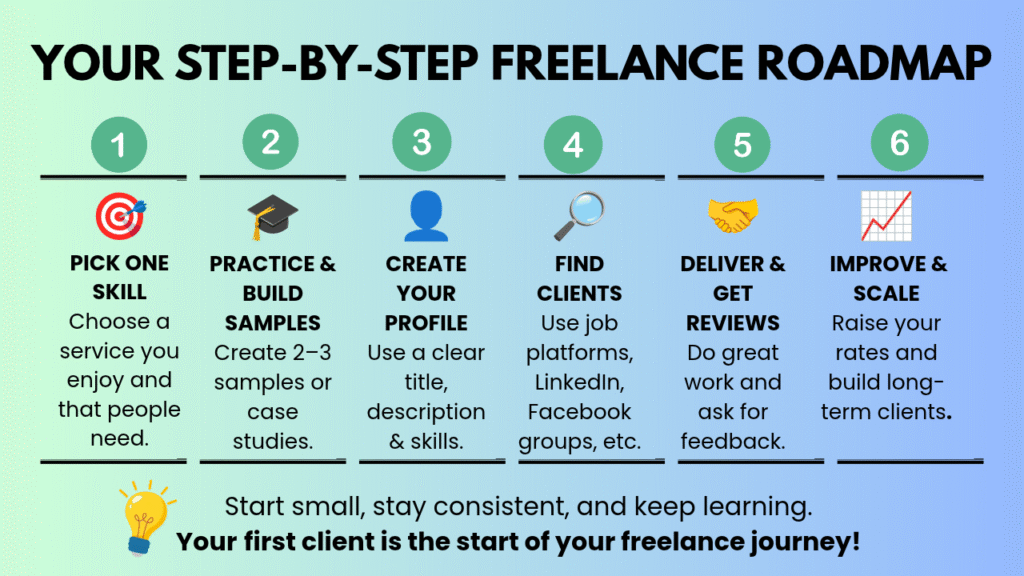
11. Your Step-by-Step Freelance Growth Roadmap
To make sure you do not get lost on your journey, here is a simplified roadmap of how your freelance business will evolve over your first year:
| Phase | Main Focus | Typical Earnings | Primary Goal |
|---|---|---|---|
| Month 1 (Launch Phase) | Skill audit, setting up portfolio, pitching daily | $0 – $300 / month | Secure first 3 paid reviews |
| Months 2–3 (Build Phase) | Refining proposals, raising entry rates | $300 – $1,000 / month | Build steady routine, land 1 retainer |
| Months 4–6 (Scale Phase) | Off-platform outreach (LinkedIn/Email) | $1,000 – $2,500 / month | Replace full-time job income |
| Year 1+ (Mastery Phase) | Specialized high-ticket services | $3,000+ / month | Full independence, premium pricing |
Final Words: Take Your First Action Today
Starting a freelance career without prior experience is not a matter of luck, secret hacks, or magic shortcuts. It is simply a step-by-step system of identifying what you can do, building basic sample proof, and showing up every single day to pitch people who need help.
Do not let the fear of having no experience keep you stuck on the sidelines. Every single top-earning freelancer you see online today started at the exact same place: with zero reviews, zero clients, and a blank screen.
Pick one small task to complete today: audit your current skills, set up a clean Google Drive folder for your samples, or write your very first dummy project. Progress happens one small step at a time!
Common Questions People Ask
You can begin to freelance by learning a particular skill from your everyday life, an academic course, or former hobbies. Following a proper beginner’s freelance guide that trains you on learning a selected tool, such as Canva or Google Analytics, may help. Freelancing without experience enables you to highlight the quality of the work rather than the years you have been in the field. Thus, instead of an extended resume, a portfolio comprising your best work will suffice.
The best websites for finding freelance gigs as a beginner are Upwork and Fiverr. A detailed Upwork guide can help beginner freelancers understand how to bid on projects. Similarly, a Fiverr guide can teach you how to create gigs or services that appeal to potential buyers on the platform. Both sites are ideal for beginners because they allow you to land your first online job without any prior freelance experience.
In addition to completing a beginner’s freelance guide, you can create sample or mock projects to include in your portfolio. For instance, you could write a product description to showcase your copywriting skills and attract brands such as Nike or Apple. Alternatively, you can offer your services for free to nonprofit organizations. These freelance tips will help you build an impressive portfolio and increase your chances of landing your first freelance job.
In most cases, knowing how to land freelance clients requires a combination of online platforms and cold email marketing. While online bidding sites offer a good chance of securing your first project, you can also use LinkedIn to identify companies or organizations that need your expertise. Cold email outreach involves contacting these shortlisted business owners and explaining how your services can help them. Therefore, avoiding the highly competitive online bidding space can be a better strategy for finding freelance clients.
Yes, you can make a living by working from home. Although it may take time to build a successful freelance career, most successful freelancers started with little or no experience. Working online allows you to develop the knowledge, skills, and mindset required in a specific field. Therefore, if you aspire to make money online, you should continue working hard on your freelancing journey while maintaining the quality of your work.
As a beginner, you may feel the need to lower your rates to compete with others in the market. However, it is essential to raise your prices over time as you gain more experience. It is always advisable to research the current freelance rates for beginners on sites such as Glassdoor. This way, you can remain profitable while meeting the expectations of your first few clients.