How to Build a Marketing Funnel for a Small Business
Many small business owners put endless hours into bringing traffic to their website or posting on social media, only to watch those hard-earned visitors leave without making a purchase or sending an inquiry. Getting traffic is only half the battle; without a system to guide those visitors toward a purchase, most of that interest simply evaporates.
If you are struggling to turn online visibility into consistent revenue, the missing piece is almost certainly a marketing funnel. In this guide, you will learn how to build a marketing funnel for a small business from scratch, how to map out each stage of the customer journey, and how to optimize your funnel so it converts casual browsers into paying customers and repeat clients.
What Is a Marketing Funnel?
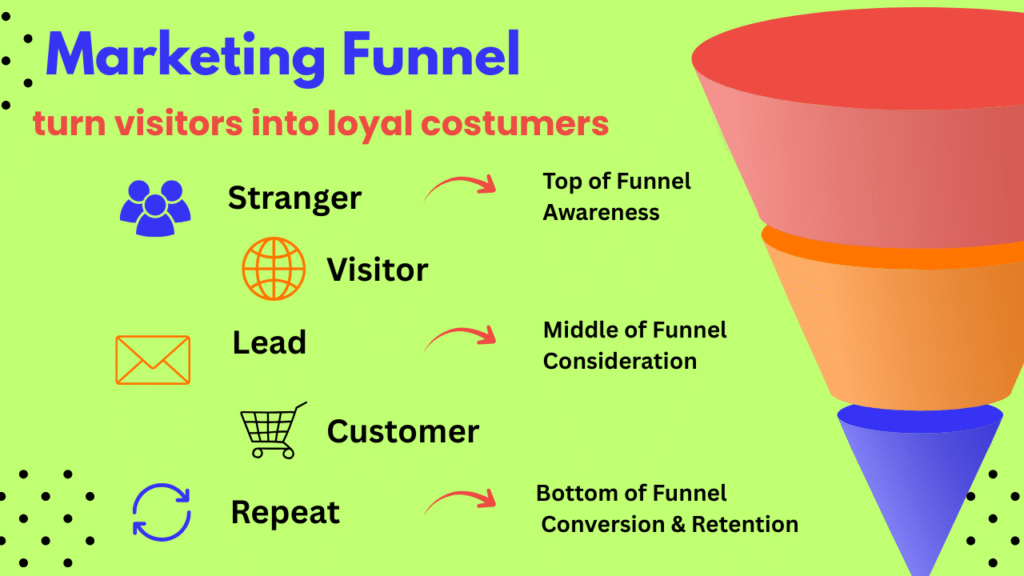
A marketing funnel is a visual model representing the journey a potential customer takes from the moment they first discover your brand all the way to buying your product or service.
It is called a “funnel” because the audience is wide at the top and narrow at the bottom. Many people will discover your business, but only a percentage of them will become leads, and an even smaller percentage will end up buying from you.
The typical progression looks like this:
Stranger → Visitor → Lead → Customer → Repeat Customer
- Stranger: Someone who has never heard of your company.
- Visitor: Someone who interacts with your content, website, or social profiles.
- Lead: Someone who shares their contact details (like an email address) in exchange for value.
- Customer: Someone who completes a transaction with you.
- Repeat Customer: A client who buys again, signs a retainer, or refers others to your brand.
Not every prospect moves through this funnel at the same speed. Some people are ready to buy immediately, while others might consume your content for six months before taking action. Furthermore, funnels look different across industries. An e-commerce store selling $20 socks might have a funnel that lasts three minutes, whereas a B2B consulting service might have a funnel that spans several weeks.
Why Do Small Businesses Need a Marketing Funnel?
Without a structured funnel, marketing often feels like throwing darts in the dark. You post online, hope for inquiries, and wonder why sales fluctuate so wildly from month to month. Building a defined funnel changes that dynamics completely.
Here are the key practical benefits:
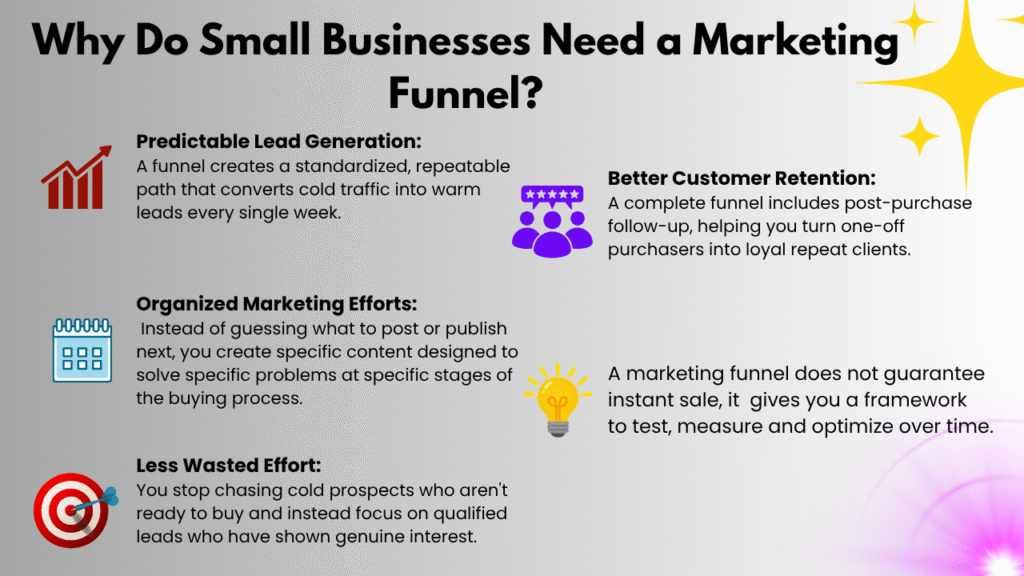
- Predictable Lead Generation: A funnel creates a standardized, repeatable path that converts cold traffic into warm leads every single week.
- Organized Marketing Efforts: Instead of guessing what to post or publish next, you create specific content designed to solve specific problems at specific stages of the buying process.
- Less Wasted Effort: You stop chasing cold prospects who aren’t ready to buy and instead focus on qualified leads who have shown genuine interest.
- Better Customer Retention: A complete funnel includes post-purchase follow-up, helping you turn one-off purchasers into loyal repeat clients.
A marketing funnel does not guarantee instant sales. It simply provides a logical framework that you can test, measure, and optimize over time to make your marketing more efficient.
The 5 Main Stages of a Marketing Funnel
To build an effective system, you need to understand the psychological stages a customer goes through.
Stage | What the Customer Is Thinking | Business Goal | Best Content & Tactics | Practical Example |
1. Awareness | “I have a problem, but I’m not sure how to fix it.” | Get noticed by the target audience. | Educational blog posts, social videos, SEO, local search. | A blog post titled How to Fix a Leaky Kitchen Faucet. |
2. Interest | “This company seems to know their stuff. Let me learn more.” | Capture contact information (generate a lead). | Downloadable checklists, templates, free guides, newsletters. | A downloadable PDF: 10-Point Plumbing Maintenance Checklist. |
3. Consideration | “Is this the best option for my specific budget and needs?” | Build trust and answer sales objections. | Case studies, comparison guides, email sequences, video demos. | An email showcasing customer reviews and a breakdown of service options. |
4. Conversion | “I’m ready to buy. How do I get started?” | Make purchasing simple and low-risk. | Free consultations, clear sales pages, money-back guarantees. | A clean booking page offering a free 15-minute diagnostic call. |
5. Retention | “That was a great experience. What else can they help me with?” | Increase lifetime value and get referrals. | Onboarding emails, loyalty discounts, referral requests. | An automated email sent 30 days later offering 15% off regular maintenance. |
How to Build a Marketing Funnel for a Small Business Step-by-Step
Building your first funnel does not require expensive tools or complex automation. Follow this step-by-step roadmap to set up a clean, high-converting customer acquisition system.
Step 1: Define Your Ideal Customer
Before creating content or landing pages, you must understand exactly who you are trying to reach. If you build a funnel for “everyone,” it will appeal to no one.
Answer these core questions:
- Who is your ideal customer? (Demographics, job title, location, lifestyle)
- What specific problem do they face? (What is keeping them up at night?)
- What outcome do they want? (What does success look like to them?)
- What objections hold them back? (Is it price, lack of time, past bad experiences?)
- Where do they search for answers? (Google, YouTube, LinkedIn, Instagram?)
Customer Persona Example:
Target: Sarah, owner of a boutique dental practice.
Problem: Her website gets visitors, but no one is booking appointments.
Desired Outcome: A steady stream of local patients booking appointments online.
Main Objection: She has burned money on ad agencies in the past with zero trackable return.
Step 2: Set One Clear Marketing Goal
Don’t attempt to build a funnel that sells products, gets newsletter subscribers, and books phone calls all at once. Pick one main objective for your initial funnel.
Common single objectives include:
- Booking a 15-minute consultation call.
- Getting a potential customer to request a quote.
- Selling a low-cost digital product or starter package.
- Securing an email sign-up for a local service offer.
Design every element of your funnel to push prospects toward this single decision point.
Step 3: Create Awareness Content
Now that you know your audience and goal, create top-of-funnel content that introduces your business to strangers searching for help.
- Service Businesses & Freelancers: Write detailed blog posts answering specific client questions to improve your search visibility. For additional insights, explore our practical strategies for growing social media organically.
- E-Commerce Stores: Create short video demonstrations or product roundups on social channels like Instagram or TikTok.
- Local Businesses: Optimize your Google Business Profile and create location-focused landing pages to capture nearby searches.
Focus strictly on being helpful. Do not pitch your primary service aggressively at this stage; focus on solving a small part of their problem.
Step 4: Create a High-Value Lead Magnet
Visitors rarely leave their contact information without a clear incentive. A lead magnet is a valuable free resource given in exchange for an email address.
To make your lead magnet effective:
- Keep it short and immediately actionable (it should take under 10 minutes to consume).
- Solve one specific micro-problem.
- Ensure it naturally leads into your main paid offer.
Effective Lead Magnet Ideas:
- Checklist: The Ultimate Pre-Launch Website Checklist
- Template: Simple Monthly Bookkeeping Spreadsheet
- Guide: 5 Mistakes Homeowners Make When Hiring a Painter
- Audit/Consultation: Free 5-Minute Account Review
Step 5: Build a Simple Landing Page
Your landing page has one job: convince the visitor to download your lead magnet or sign up for your offer. Keep the layout clean, distraction-free, and mobile-friendly.
Ensure your landing page includes these core components:
- Clear Headline: Explain the core benefit immediately (e.g., “Save 5 Hours a Week on Payroll with This Free Template”).
- Supporting Copy: Brief bullet points highlighting what the visitor will learn or gain.
- Simple Opt-in Form: Ask only for necessary details—usually just a first name and email address. Asking for too much information upfront drops conversion rates dramatically.
- Call to Action (CTA) Button: Use action-oriented text on the button, like “Send Me the Free Guide.”
- Trust Signals: Include a brief testimonial, client logo, or privacy guarantee.
Step 6: Set Up an Automated Email Follow-Up Sequence
Once someone opts into your list, use an automated email welcome sequence to nurture the lead. This builds familiarity and trust before you make a direct sales pitch.
Here is a proven 5-email sequence framework:
- Email 1 (Immediate): Deliver the promised lead magnet, welcome them, and set expectations for future emails.
- Email 2 (Day 1): Provide additional value related to the topic without asking for anything in return.
- Email 3 (Day 3): Discuss a common mistake your prospects make and how to avoid it.
- Email 4 (Day 5): Share a short case study, testimonial, or story demonstrating how you helped a past client achieve results.
- Email 5 (Day 7): Make a clear, direct offer to work together, encouraging them to book a call or order your service.
Step 7: Craft a Compelling Main Offer
When prospects reach the end of your nurture sequence, your offer needs to be clear, attractive, and straightforward.
Make your offer compelling by focusing on:
- Clear Value: Describe the exact transformation or end result, not just features.
- Simple Pricing: Avoid overly confusing pricing structures or hidden fees.
- Risk Reduction: Offer a satisfaction guarantee, clear cancellation policy, or a low-risk trial to reduce initial friction.
Avoid using fake countdown timers or artificial scarcity, as these tactics diminish long-term trust in small business brands.
Step 8: Use Strategic Calls to Action (CTAs)
Match your CTA to where the prospect is within your funnel. Avoid asking someone to “Buy Now” when they just discovered your site five seconds ago.
- Awareness Stage: “Read the Full Guide” / “Learn More”
- Interest Stage: “Download Free Checklist” / “Get the Template”
- Consideration Stage: “See How It Works” / “View Case Studies”
- Conversion Stage: “Book Your Free Consultation” / “Claim Your Spot”
- Retention Stage: “Reorder Today” / “Join the VIP Club”
Focus on placing one primary CTA per page or email so visitors aren’t confused by competing options.
Step 9: Re-Engage Visitors with Retargeting
Not everyone converts on their first visit. Retargeting helps you stay top-of-mind with people who engaged with your business but didn’t complete the desired action.
You can set up retargeting ads (on platforms like Meta or Google) targeted specifically at users who:
- Visited key service pages but didn’t fill out the contact form.
- Viewed your landing page but didn’t submit their email.
- Added an item to a cart without completing checkout.
Retargeting is optional when starting out, but it offers a cost-effective way to recover potentially lost leads once you have baseline web traffic.
Step 10: Track Performance and Optimize
Building the funnel is only step one. To maximize revenue, track these fundamental performance metrics:
- Website Traffic: How many visitors are entering the top of your funnel?
- Landing Page Conversion Rate: What percentage of page visitors sign up for your lead magnet? (Aim for 20%–40%).
- Email Open & Click Rates: Are people reading your sequence and clicking your links?
- Sales Conversion Rate: What percentage of overall leads become paying customers?
- Customer Acquisition Cost (CAC): How much money or effort does it take to get a single customer?
Regularly audit your numbers to identify bottlenecks. If your landing page converts well but no one buys from your emails, focus on tweaking your sales offer and email messaging.
A Practical Marketing Funnel Example for a Small Business
Let’s examine how this works in practice for a local service company, such as a small web design studio.
- Awareness: A local gym owner searches Google for “how to get more members from the website.” They land on a helpful blog post written by the web studio titled 7 Reasons Local Gym Websites Fail to Get Leads.
- Interest: At the bottom of the article, the gym owner sees a CTA: “Download our Free 10-Point Website Redesign Checklist.”
- Consideration: They click the link, visit a dedicated landing page, and enter their email to get the checklist. Over the next week, they receive three helpful automated emails with advice on mobile design and user experience.
- Conversion: The fourth email offers a “Free 15-Minute Video Website Audit.” The gym owner books the audit, appreciates the clear advice, and decides to hire the studio for a full website overhaul.
- Retention: After launching the new site, the agency offers an ongoing monthly site maintenance retainer and asks for a testimonial.
Marketing Funnel vs. Sales Funnel: What’s the Difference?
While many marketers use these terms interchangeably, there is a subtle distinction between the two:
- Marketing Funnel: Focuses on broad audience engagement, brand awareness, lead generation, and initial education. It takes a stranger and turns them into a warm lead.
- Sales Funnel: Focuses on the deal closure process. It takes that warm lead, presents specific proposals, handles sales objections, and processes payment.
In small business environments, marketing and sales funnels typically merge into a single seamless system managed by the owner or a small team.
How Much Does It Cost to Build a Marketing Funnel?
You do not need an enterprise budget to build a functional funnel. The cost scales directly with your budget and resources:
- Low / Free Budget: Use your existing website (WordPress, Wix, Squarespace), free marketing tools (like Mailchimp or MailerLite free tiers), organic social posts, and basic Google Analytics. Cost: $0 – $30/month.
- Growing Business Budget: Invest in specialized landing page software (e.g., Leadpages), an upgraded email marketing provider, a calendar booking tool (like Calendly), and light CRM software. Cost: $50 – $200/month.
- Advanced Funnel Budget: Implement advanced marketing automation suites, custom CRM integrations, high-converting video hosting, and dedicated paid retargeting campaigns. Cost: $300+/month.
Focus on building a clean strategy before buying software. Expensive tools cannot fix a weak offer or bad messaging.
How Long Does It Take to Build a Funnel?
Setting up a basic funnel—writing a simple lead magnet, creating a single landing page, and writing a 3-email sequence—typically takes 1 to 2 weeks for a small business owner working part-time on it.
However, optimizing that funnel is an ongoing effort. It usually takes 30 to 90 days of gathering real traffic data to see how well your funnel converts and make necessary adjustments to copy, offer details, and traffic sources.
Common Marketing Funnel Mistakes to Avoid
- Targeting Everyone: Failing to define a specific persona makes your copy vague and unconvincing.
- Selling Too Soon: Pitching expensive services immediately on the first touchpoint scares off potential prospects.
- Ignoring Mobile Users: Over 50% of web traffic comes from mobile devices; ensure your landing pages and opt-in forms load quickly on mobile.
- Asking for Too Much Information: Requiring phone numbers, company size, and addresses on simple lead forms drops conversion rates.
- No Email Follow-Up: Capturing leads but failing to send nurture emails lets warm prospects cool off.
- Forgetting Existing Customers: Neglecting post-purchase follow-up leaves repeat sales and referral revenue on the table.
- Not Tracking Data: Running a funnel without monitoring traffic numbers or conversion rates makes it impossible to know what needs fixing.
Essential Tools to Build Your Marketing Funnel
To assemble your funnel, you generally need tools across a few basic categories:
- Website / CMS: WordPress, Wix, Squarespace.
- Landing Page Builders: Elementor, Leadpages, Unbounce (or native pages built inside your CMS).
- Email Marketing & Automation: MailerLite, ConvertKit, ActiveCampaign, Mailchimp.
- Form Builders: Gravity Forms, Typeform, WPForms.
- Scheduling Tools: Calendly, Acuity Scheduling.
- Analytics:Google Analytics 4, Search Console.
Start with simple, user-friendly tools that integrate easily with your existing website platform. To streamline your process, check out our guide on leveraging AI tools for content creation and funnel setup.
Frequently Asked Questions
It is a structured model that maps out how a small business turns strangers into visitors, leads, paying customers, and long-term clients through targeted content, lead capture, and follow-up messaging.
Start by identifying your target customer and creating one specific lead magnet (like a free guide). Build a simple landing page to capture email addresses, and set up an automated 3-to-5 email sequence that provides value before pitching your primary service or product.
Yes. You can drive traffic to the top of your funnel using free, organic methods such as search engine optimization (SEO), social media content, local network referrals, and guest posting. For a deeper dive into free traffic strategies, read our guide to increasing website traffic.
The five primary stages are Awareness (discovering the brand), Interest (learning more/downloading a resource), Consideration (evaluating solutions), Conversion (making a purchase), and Retention (becoming a repeat customer).
A healthy landing page conversion rate for a free lead magnet generally falls between 20% and 40%. For a direct paid sales offer, typical conversion rates range from 2% to 5%, depending on price point and industry.
Focus on creating helpful, problem-solving content tailored to search engine intent, optimizing your website for local search terms, and sharing educational posts consistently on social platforms where your audience hangs out.