How to Increase Website Traffic Without Paid Ads
Building a website or starting a new blog is an exciting milestone, but published pages don’t automatically attract visitors. You might spend days writing detailed guides or designing a clean online store, only to open your analytics account and see single-digit traffic numbers.
When website growth stalls, paid advertising often seems like the quickest solution. While running ads can deliver fast hits to your site, it requires a continuous financial budget. The moment you pause your ad campaigns, that traffic stream vanishes.
Increasing your website traffic without paying for advertising requires a different mindset. Instead of buying attention, you earn it by offering real value. Organic growth relies on creating helpful content, applying basic search engine optimization (SEO), maintaining publishing consistency, and promoting your work where your audience hangs out. It takes effort and patience, but it builds long-term momentum that continues to bring in visitors without ongoing costs.
Can You Increase Website Traffic Without Paid Ads?
You can grow a steady stream of website visitors without spending money on advertisements. The key difference between paid traffic and organic growth comes down to time versus money. Paid ads offer immediate placement at a fixed cost per click, whereas organic channels require time, effort, and strategic patience upfront to yield results later.
Understanding where your traffic comes from helps you decide where to focus your effort:
- Organic Search Traffic: Visitors who find your site through search engines like Google or Bing after searching for a keyword or question.
- Referral Traffic: People who click a link to your site from another website, blog, or online directory.
- Social Traffic: Users who discover your content through social media channels like LinkedIn, Pinterest, or Reddit.
- Direct Traffic: Readers who type your URL directly into their web browser or use a saved bookmark.
Organic growth is a gradual process. You rarely see overnight spikes, but steady work across search, social, and referral channels helps build a consistent baseline of visitors over time.
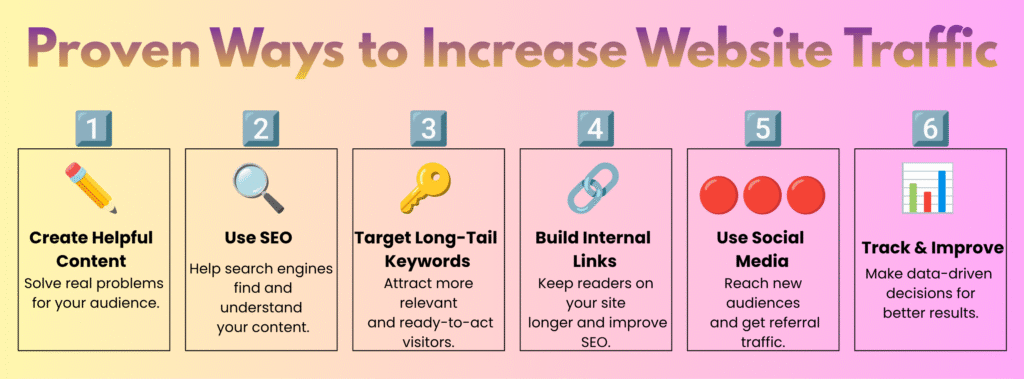
1. Create Content That Solves Real Problems
The most reliable way to attract organic visitors is to publish content that helps people solve specific problems. When users search online, they are usually looking for answers, instructions, or comparisons to help them make a decision.
Generic articles that cover broad topics superficially rarely build an audience. Instead, focus on narrow, practical subjects that address real questions.
Consider these practical content formats:
- Beginner-Friendly Guides: Step-by-step walkthroughs that introduce basic concepts clearly.
- Troubleshooting Tutorials: Specific instructions on how to fix a technical problem or complete a task.
- Comparison Articles: Objective breakdowns highlighting the differences between two tools, products, or approaches.
- Checklists and Worksheets: Downloadable or copy-paste resources that simplify a complex workflow.
For instance, an article titled “General Fitness Tips” faces intense competition and offers little immediate value. A targeted guide titled “How to Set Up a Home Gym in a Small Apartment on a $200 Budget” answers explicit questions for a defined audience. That specificity makes it far more likely to attract interested readers.
2. Use SEO to Get Free Search Traffic
Search engine optimization (SEO) is the practice of structuring and writing your content so search engines can easily understand and display it to users. SEO isn’t about gaming the system or repeating keywords continuously; it is about serving search intent—delivering exactly what the user expected to find when they entered their search query.
Focus on these fundamentals when optimizing your pages:
- Search Intent: Match the tone and depth of your content to what the searcher actually wants, whether that is a quick answer, a tutorial, or a product list.
- Natural Keyword Placement: Include primary search terms naturally in your title, main headings, and body copy without forcing them.
- Clear Page Titles: Write concise page titles that accurately describe the page content while encouraging clicks.
- Descriptive URLs: Keep page links short, clear, and readable (e.g., [yoursite.com/small-apartment-gym](https://yoursite.com/small-apartment-gym)).
- Image Optimization: Add clear, descriptive alternative text (alt text) to images so search engines and screen readers understand their context.
- Internal Linking: Link to relevant articles on your own site to guide readers to deeper information.
When your content thoroughly resolves a user’s query, search engines are far more likely to index and recommend your pages over time.
3. Target Long-Tail Keywords
For newer or smaller websites, targeting broad search terms can make it difficult to earn search visibility against established sites. Long-tail keywords offer a far more practical entry point.
Long-tail keywords are longer, more specific search phrases. They generally receive lower monthly search volume individually, but they carry clearer search intent and face significantly less competition.
- Broad Keyword: “Website traffic” (High competition, general intent)
- More Specific: “How to increase website traffic without paid ads” (Moderate competition, clear intent)
- Highly Targeted: “How to increase blog traffic for a new food blog” (Lower competition, extremely specific intent)
A reader searching for a targeted phrase knows precisely what they need. By creating content that directly matches these specific queries, small websites can attract qualified visitors much faster than by competing for high-volume broad terms.
4. Improve Your Existing Content
Increasing traffic doesn’t always require publishing brand-new pages from scratch. Most established websites have older posts that already receive small amounts of impression data in search engines. Updating these older pages can deliver significant traffic improvements with minimal effort.
Regularly audit your content library and update existing posts using these practical steps:
- Replace outdated facts, dead links, or obsolete screenshots.
- Add missing sections to cover fresh developments or answer new questions.
- Simplify introductory paragraphs to get straight to the point.
- Improve formatting by converting dense text blocks into bullet points or tables.
- Add new internal links to relevant posts published more recently.
Refreshing content keeps your information accurate for readers and signals to search engines that your site is actively maintained.
5. Build a Strong Internal Linking Structure
Internal links are hyperlinks that connect one page on your website to another page on the same domain. They are crucial for user experience and site architecture.
Internal links help your site in three major ways:
- Improves Discovery: They guide visitors to related topics, keeping them on your site longer.
- Clarifies Hierarchy: They help search engines understand the relationship between different pages on your site.
- Distributes Page Value: They pass authority from higher-performing pages to newer or deeper content.
When adding internal links, use descriptive anchor text instead of generic phrases. For example, use “Read our full guide on basic keyword research” instead of “Click here.” Ensure the destination page offers logical value to the reader at that exact point in their reading journey.
6. Use Social Media to Promote Your Content
Social platforms offer useful distribution channels for generating referral traffic without ad spend. Simply dropping raw article links repeatedly across accounts won’t drive engagement. Social media platforms prioritize posts that keep users on their network, so value-first native formatting is essential.
Adapt your content for specific platforms:
- LinkedIn: Share a practical industry lesson learned, then place the full article link in the post text or comments.
- Pinterest: Create tall visual graphics or checklists that link directly back to tutorial blog posts.
- X (Twitter): Break down key takeaways from an article into an easy-to-read educational thread.
- Reddit: Participate in communities relevant to your niche. Share thorough text guides directly in the forum, referencing your site only when contextually relevant and allowed by group rules.
Always focus on delivering value directly inside the social post first, using your website as a resource for readers who want deeper details.
7. Answer Questions Where Your Audience Already Hangs Out
Every day, people post questions across community platforms like Quora, specialized forums, and niche Facebook groups. Answering these questions thoughtfully allows you to demonstrate your knowledge and introduce your website to interested users.
When using Q&A platforms:
- Write complete, helpful answers directly inside the community forum.
- Avoid automated responses or copy-pasting promotional pitches.
- Only link to your blog post if it provides additional context, such as a detailed template or step-by-step diagram.
Avoid mass posting or dropping unexplained links. Communities penalize spam quickly, whereas genuine, detailed contributions build long-term referral traffic and industry credibility.
8. Build Relationships and Earn Backlinks Naturally
A backlink is a link placed on an external website that points back to your site. Search engines view backlinks as external endorsements, which can help strengthen your site’s overall search visibility over time.
Earning quality backlinks without buying them requires creating resources that other writers, bloggers, and site owners naturally want to cite.
Focus on these organic tactics:
- Original Data and Research: Conduct small surveys or compile unique industry statistics people can cite in their own content.
- Comprehensive Free Tools or Calculators: Build simple online utilities or templates that solve common daily tasks.
- Guest Contributions: Write informative articles for reputable sites within your industry that accept guest authors, including a subtle link back to your resource where relevant.
- Digital Outreach: Contact content creators when you find broken links on their site, offering your fresh, relevant guide as a suggested replacement.
Avoid buying links, joining automated link exchange networks, or dropping link spam in comment sections. Buying links or participating in manipulative link schemes can violate search engine guidelines and may negatively affect your website’s search visibility.
9. Make Your Website Faster and Easier to Use
User experience directly influences whether a visitor stays on your website or returns to search results. If your pages load slowly, display misaligned text on mobile phones, or overwhelm readers with pop-up banners, visitors will leave quickly.
Keep your site fast and easy to navigate:
- Mobile Responsiveness: Ensure layout elements, text sizes, and touch buttons adjust seamlessly for mobile screen sizes.
- Page Load Speed: Compress images, remove unnecessary plugins, and optimize your website so pages load quickly and smoothly.
- Scannable Formatting: Break up text with descriptive headings, short paragraphs, bold emphasis, and structured bullet lists.
- Clean Navigation: Keep main menu bars simple so users can find key categories without confusion.
A clean, responsive website keeps readers engaged, reducing bounce rates and encouraging multi-page browsing sessions.
10. Use Email to Bring Visitors Back
Social media channels and search engines continually update their algorithms, which can impact your visibility without notice. Building an email list gives you a direct line of communication with people who have already expressed interest in your content.
Simple, non-intrusive strategies to build an email subscriber base include:
- Offering a simple email signup form in your site sidebar or footer.
- Providing a free downloadable asset (like a PDF checklist or template) in exchange for joining your newsletter.
- Sending short, regular email updates whenever you publish a comprehensive new article or resource.
Email updates generate repeat traffic from highly engaged readers who are far more likely to share your work or buy your products over time.
11. Create Content in Different Formats
Producing a comprehensive blog post takes significant time and effort. Rather than publishing a post once and moving on, repurpose the main insights into multiple content formats to reach audiences on different platforms.
- Blog Post → Social Carousel: Convert main article subheadings into a visual slide deck for LinkedIn or Instagram.
- Blog Post → Short Video: Record a brief 60-second video explaining the core solution for YouTube Shorts or TikTok.
- Tutorial → Downloadable Checklist: Turn a complex guide into a one-page printable PDF reference.
- Research Post → Infographic: Summarize statistical findings into an easily shareable visual chart.
Repurposing content allows you to maximize the value of your initial research without having to draft brand-new ideas daily.
12. Track What Is Actually Working
Growing organic traffic effectively requires making decisions based on real data rather than guesses. Use free analytical tools like Google Analytics and Google Search Console to monitor how visitors find and interact with your site.
Focus on these essential metrics:
- Top Landing Pages: Identify which pages attract the highest number of organic visitors.
- Search Queries: See the exact terms people type into search engines before clicking your links.
- Referral Sources: Track which external blogs or social platforms send you the most traffic.
- Average Engagement Time: Observe how long readers stay on your pages to evaluate content quality.
Use this data to refine your ongoing efforts. If a specific topic brings in high traffic, consider writing related follow-up articles to cover that subject in greater depth.
Common Mistakes That Can Hurt Organic Traffic
When trying to increase website traffic without paid ads, avoiding common pitfalls is just as important as implementing good strategies.
- Publishing Low-Quality Content Fast: Releasing dozens of short, generic posts rarely works. A well-researched, helpful article is generally more valuable to readers than publishing large numbers of shallow posts.
- Keyword Stuffing: Forcing exact search terms into sentences repeatedly makes content hard to read and lowers search quality scores.
- Ignoring Mobile Users: Over half of all global web traffic originates on mobile devices. Sites optimized only for desktop view lose significant traffic opportunities.
- Buying Low-Quality Backlinks: Purchasing cheap link packages harms your domain’s credibility and risks search engine penalties.
- Expecting Immediate Results: Organic traffic development takes time. Quitting after a few weeks prevents long-term SEO efforts from compounding.
Focusing on reader value and technical usability protects your website from these avoidable setbacks.
How Long Does It Take to Increase Website Traffic Without Paid Ads?
Organic traffic growth is a gradual process. There is no fixed timeline for SEO results. A new website may start receiving search impressions relatively quickly, but building consistent organic traffic can take months or longer depending on competition, content quality, website authority, and other factors. Older, established domains with clean histories often see updates reflect much faster.
Timeline expectations vary depending on several key factors:
- Domain Age: New websites often have less established content and fewer external signals, so building search visibility can be more challenging than it is for an established site.
- Topic Competition: Niching down into specific, less competitive industries yields quicker traffic growth than saturated markets.
- Publishing Frequency and Quality: Maintaining a consistent publishing schedule of well-researched articles builds momentum faster than sporadic posting.
- Promotion Efforts: Sharing useful resources active across relevant niche communities can generate immediate referral traffic while long-term search rankings build up.
Consistency is essential. Organic growth compounds over time, with work completed today often delivering traffic months into the future.
Simple 30-Day Organic Traffic Plan
If you’re unsure where to start, follow this realistic four-week plan to kickstart your organic growth:
Week 1: Research and Audit
- List 10 specific questions your target audience asks regularly.
- Research long-tail search terms related to those topics.
- Check your site’s mobile layout and speed using online testing tools.
- Fix broken links or formatting errors on existing core pages.
Week 2: Content Creation and Optimization
- Write two thorough, practical articles answering two of your audience questions.
- Include descriptive titles, organized H2 headings, and short, readable paragraphs.
- Add relevant internal links connecting your new posts to existing pages on your site.
- Compress all uploaded images and write clear descriptive alt text.
Week 3: Promotion and Networking
- Summarize your new content into helpful social media threads or carousel posts.
- Participate in two relevant online forums or subreddits by answering user questions accurately.
- Reach out to two non-competing websites in your niche to discuss content collaborations or guest contributions.
Week 4: Review and Refine
- Check your site analytics to see which pages received search impressions or referral clicks.
- Identify pages with low engagement and make small formatting or text improvements.
- Plan your content calendar for the next month based on top-performing topics.
Frequently Asked Questions
Can I increase website traffic without spending money?
Yes, You can grow your website traffic organically by writing useful content, optimizing pages for search engines, sharing resources on social media, participating in online communities, and building email newsletter lists. These methods require time and consistent effort rather than advertising spend.
What is the best free way to get website traffic?
The most reliable free method is search engine optimization (SEO) focused on long-tail keywords. Creating high-quality content that thoroughly answers specific user questions allows you to earn recurring organic search traffic over time.
How long does SEO take to increase traffic?
SEO does not have a guaranteed timeline. Some pages may gain visibility relatively quickly, while building consistent organic traffic can take months or longer. Established websites with existing backlink profiles and high-quality content often see ranking updates faster when publishing new posts or updating existing content.
Do social media platforms help increase website traffic?
Yes, social platforms generate valuable referral traffic. To get results without paying for ads, format your content natively for each platform by sharing practical takeaways, carousels, or short educational posts that naturally direct users back to your website for full details.
How often should I publish blog posts?
Quality and consistency matter far more than publishing high volumes of shallow content. Publishing one detailed, well-researched article per week—or even every two weeks—is usually more effective for organic growth than posting daily low-quality articles.
Are backlinks still important for SEO?
Yes. Relevant backlinks can be an important signal for search visibility, especially when they come naturally from reputable and relevant websites.
Why is my website getting traffic but no conversions?
If visitors arrive on your site but don’t take action, your content may not match their search intent, or your call-to-action buttons might be unclear. Ensure your traffic sources bring in targeted readers, improve your page loading speed, and make next steps clear and easy to find on every page.
Conclusion
Increasing website traffic without paying for ads requires patience, clear planning, and a consistent focus on helpfulness. Paid advertising can buy temporary traffic spikes, but organic growth strategies establish a self-sustaining foundation for your website over time.
Focus on solving real problems for your readers, optimizing your content for search engines, keeping your site fast, and promoting your work where your audience naturally spends time. Track your analytics to see what works, refine underperforming pages, and stay consistent with your efforts. Attracting the right, engaged audience yields far better long-term results than simply chasing high traffic numbers.